




Most sleep advice obsesses over eight hours, but a growing body of research suggests that when you sleep is just as important as the duration.
New data from 103,490 Ultrahuman Ring AIR users backs that up. The research carried out by Ultrahuman’s Science team found that the least consistent sleepers had overnight resting heart rates 2–4 bpm higher than the most consistent ones.
It sounds like a small number, but an elevated overnight heart rate points to a higher physiological load – the body running warmer, working harder, and recovering less, even while you sleep.
It also complements an Ultrahuman study with Stanford University, which indicated that bedtime consistency was a key driver of glucose control and metabolic health.
Combined, it suggests that the importance of keeping a consistent sleep schedule has been overlooked in favour of duration. But it can be a powerful lever for overall health and longevity.
Highlights
- 103,490 Ultrahuman members were compared on sleep-timing consistency.
- Regular sleepers displayed 1.9 – 3.6 bpm lower overnight heart rate in every age band.
- The gap held regardless of sleep duration.
Why your sleep timing matters, not just your sleep length
Think of your circadian system as a thermostat. Your internal clock cues your heart, your hormones, and your digestion to rise and fall on a schedule that resets every time you sleep. When you go to bed at significantly different times, the thermostat keeps getting reset at the wrong hour. Your heart runs warmer than it should overnight, and the autonomic nervous system that should be powering down stays half-on.
Researchers formalised this intuition in 2017 with the Sleep Regularity Index, a score for how consistently you are asleep at the same times every 24 hours (Phillips et al., Scientific Reports 2017, PMID: 28607474).
A 2024 study in 60,977 UK adults then found that this regularity beat sleep duration for predicting all-cause mortality: the most regular sleepers had up to a 48% lower risk than the least regular ones, even after adjusting for how long they slept (Windred et al., Sleep 2024, PMID: 37738616).
What we found in the ring data
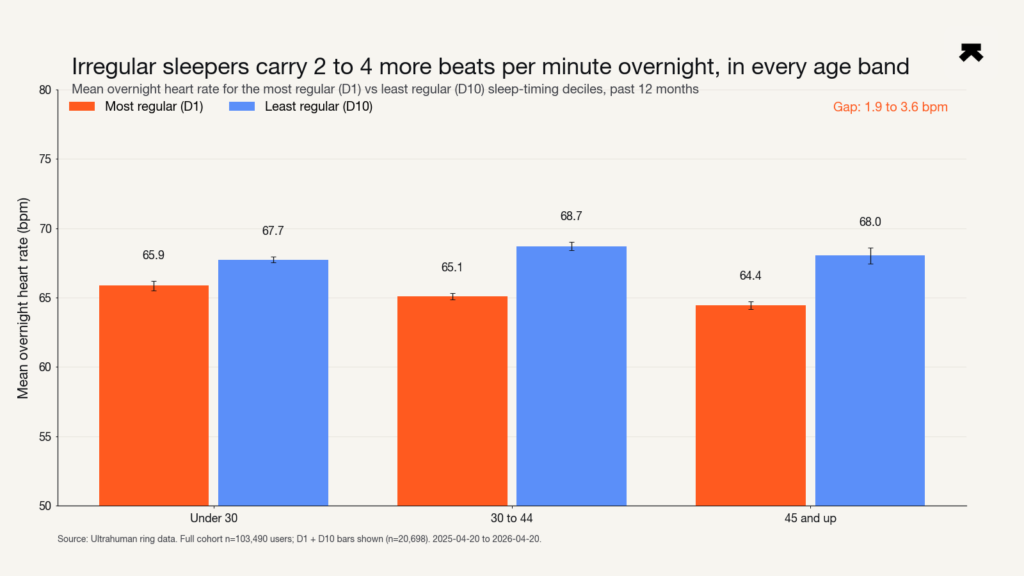
We looked at 103,490 Ultrahuman members with at least 180 valid ring nights in the past year and at least 30 in the last three months – committed, currently-active ring wearers. For each one, we calculated how much, in minutes, their sleep midpoint drifts from night to night.
Then we split everyone into ten groups of regularity within their age band and compared overnight resting heart rate between the steadiest sleepers (decile 1) and the most erratic (decile 10):
| Age band | D1 most regular | D10 least regular | Gap |
|---|---|---|---|
| Under 30 | 65.9 bpm | 67.7 bpm | +1.9 bpm |
| 30 to 44 | 65.1 bpm | 68.7 bpm | +3.6 bpm |
| 45 and up | 64.4 bpm | 68.0 bpm | +3.6 bpm |
We then split each age band by how long members actually slept. The gap persisted in both the shorter and longer halves. The regularity signal is doing real work on top of duration, not because of it.
Why this matters for your heart
Overnight resting heart rate is a long-standing cardiovascular marker. Lower values line up with better cardiorespiratory fitness and a steadier autonomic balance. A 3 to 4 bpm offset is not alarming in isolation, but it is the kind of shift you see between sedentary and moderately fit adults, compounded night after night for years.
A follow-up UK Biobank analysis in 82,391 people tied sleep regularity to lower dementia risk as well.
Members with a Sleep Regularity Index above 70 had a 26% lower dementia risk than those below, and the protective effect held in both short and long sleepers (Bian et al., BMC Public Health 2025, PMID: 39920677).
What you can do
- Pick a bedtime window and stick to it – even on weekends. A weekend that shifts your bedtime by more than an hour is a common source of midsleep drift. On a flexible week, aim to keep bedtime within a 30-minute band most nights.
- Watch your sleep midpoint, not just your sleep length. Your Ultrahuman Ring logs both automatically. A midpoint that wanders by more than an hour between nights is the signal to double down on sleep consistency.
- Anchor your mornings, not your evenings. Waking at a consistent time is easier than falling asleep at one. Focus on getting up at a specific time, create a good morning routine, and try to take a short walk or get natural light as soon as you can.
- Use duration as a floor, not a ceiling. Regularity works on top of duration, not instead of it. A steady bedtime with seven hours of sleep is stronger than a drifting bedtime with nine.
This analysis describes patterns in Ultrahuman ring data. It does not establish cause and effect, and it is not medical advice. If a sudden shift in your overnight heart rate surprises you, bring the trend to your physician rather than adjusting anything on your own.