




Heart rate variability (HRV) is one of the core signals wearables like the Ultrahuman Ring use to assess recovery and physiological stress.
HRV is highly individual, but it follows population-level patterns. It typically declines with age, from a median of 47ms in adults in their 20s to around 34ms by the 60s.
Direct comparison against other people isn’t clinically meaningful, but many people want reassurance that their numbers fall within a normal range. This guide provides that orientation and reveals how to read your own HRV properly.
Read more: What is HRV? Read our in-depth guide
The brackets below are built from Ultrahuman Ring data: over 528,000 users across 79 million nights of sleep. They replicate the age-related decline established in landmark cardiology research, at a scale those studies couldn’t reach.
One caveat worth stating up front: lifestyle factors — sleep, training, alcohol, stress — can shift HRV meaningfully at any age. Use the chart for orientation, but the signal that actually matters is the trend in your own HRV over time, measured across multiple nights against your personal baseline.
Let’s get started.
What HRV measures and why it varies by age
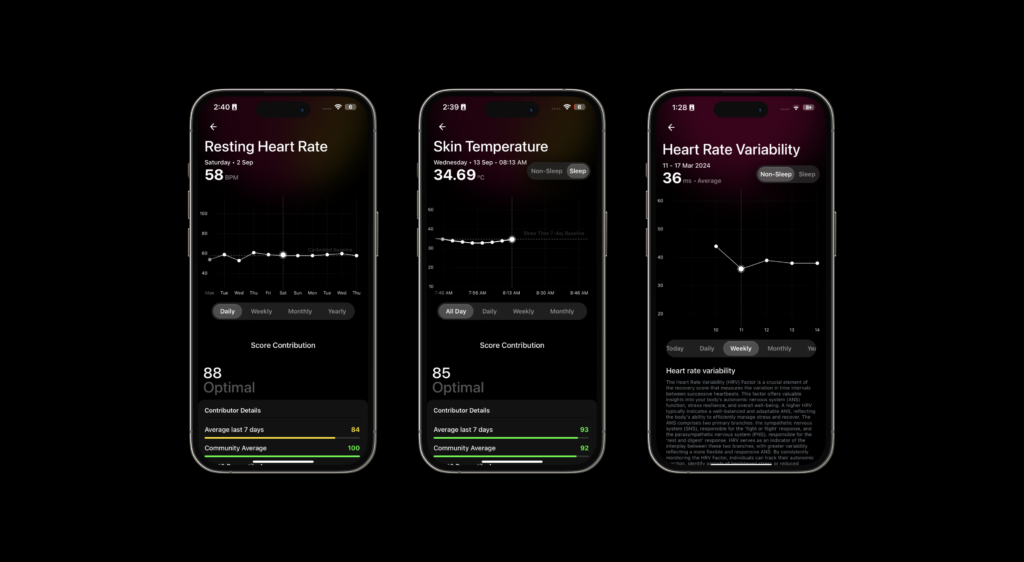
HRV is the variation in time between consecutive heartbeats, in milliseconds. A high HRV means your nervous system flexes well — switching between active and rest states smoothly. A low HRV signals that the parasympathetic (rest-and-digest) arm of the autonomic system is dampened, often by stress, poor sleep, illness, or aging.
Most Ring users see HRV reported as RMSSD (root mean square of successive differences), measured overnight during sleep. RMSSD is one of the most commonly used time-domain HRV metrics, and HRV norms vary substantially by the measurement window used — ultra-short, short-term, and 24-hour readings are not directly interchangeable (Shaffer & Ginsberg, Front Public Health 2017, PMID 29034226).
Age is one of the strongest determinants of baseline HRV. A landmark study of 260 healthy subjects across nine decades found that HRV declines with aging, with the pattern varying by which HRV measure is used (Umetani et al., J Am Coll Cardiol 1998, PMID 9502641). The Ring dataset confirms this at scale.
HRV norms at each decade
The table below shows overnight HRV by age decade in the Ultrahuman Ring user population.
| Age band | Median HRV (ms) | Typical range (25th–75th percentile) | Mean HRV (ms) |
|---|---|---|---|
| 20–29 | 47 | 37–59 | 49.5 |
| 30–39 | 42 | 33–53 | 44.4 |
| 40–49 | 38 | 30–48 | 40.2 |
| 50–59 | 35 | 27–45 | 37.6 |
| 60–69 | 34 | 26–45 | 37.4 |
| 70+ | 36 | 27–48 | 40.1 |
Two takeaways from the chart:
- HRV falls roughly 12–15 ms from the 20s to the 60s. The steepest drop is between the 20s and 30s (median 47 → 42); the decline is gradual after that.
- The “normal” range is wide at every age. A 35-year-old with HRV 33 sits in the lower band of their age range; another at HRV 53 sits in the upper band. Both fall within this cohort’s interquartile range. Your trend matters more than the absolute number.
The slight uptick in the 70+ row likely reflects survivor selection — older adults who continue to wear a Ring tend to be in better cardiovascular health than the general 70+ population.
Note: This chart is built from anonymized Ultrahuman Ring overnight HRV (RMSSD) records — 528,935 users across 79 million nights of sleep, ages 20–80+. Sample sizes per age band: 20–29 (195K users, 29M nights); 30–39 (170K / 25M); 40–49 (80K / 12M); 50–59 (53K / 8M); 60–69 (23K / 3M); 70+ (8K / 1M). Aggregated across both sexes; each night counts equally rather than averaging within-user first (night-weighting), which gives a stable population-level view but lets heavy users contribute proportionally more nights of data. Analysis run 2026-05-21. Ring users are a self-selected population of health-aware adults, so the median values are likely a touch higher than what you would see in a fully random sample. Observational wearable data, not a clinical study.
Why HRV declines with age
The decline tracks the parasympathetic nervous system’s gradual loss of tone. As we age, vagal-nerve-mediated control of the heart weakens, which compresses the beat-to-beat variation HRV measures. Voss and colleagues showed this effect is detectable in short-term recordings of healthy adults and that the magnitude differs subtly between men and women, especially in the younger age bands (Voss et al., PLoS One 2015, PMID 25822720).
Three drivers compound the age effect:
- Reduced cardiovagal tone — the rest-and-digest signal arrives less reliably at the heart with age.
- Reduced autonomic flexibility — the heart’s ability to shift rate quickly in response to demand drops.
- Cumulative stressor exposure — chronic sleep loss, alcohol, and persistent stress narrow HRV gradually over decades.
The implication: the decade-to-decade drop is real but slow. A sharp HRV decline within a single year is not a normal aging signal — it is a lifestyle signal.
How to read your own HRV against the chart
Two interpretation rules matter more than the absolute number:
Compare to your own baseline first: Track several weeks of overnight HRV to establish a personal baseline, as recommended in HRV monitoring practice (Plews et al., Sports Med 2013, PMID 23852425). Substantial day-to-day swings are common in healthy adults; the trend across weeks is the signal that matters.
Compare to your age band second. If your two-week rolling average sits in the bottom quartile of your age band on the chart, that is worth examining — though it is rarely a stand-alone cause for concern in the absence of symptoms.
Common reasons your HRV reads low without anything being clinically wrong:
- Late, large, or alcohol-paired dinners
- A hard training session in the days before (HRV typically drops with training stress and rebounds with recovery)
- Sleep deprivation or jet lag
- Acute illness (HRV can drop before subjective symptoms appear)
- Measurement noise (poor Ring fit, motion artifacts, brief recording window)
For a deeper look at what trips up HRV measurement, see Ultrahuman’s guide to 5 HRV measurement mistakes.
How to improve HRV at any age
The most reliable levers — sleep, recovery, training stress management, and alcohol reduction — work at every age band. Their effect sizes are often larger than a typical decade-of-aging drop — the chart’s downward trend isn’t destiny.
Prioritize sleep consistency. Going to bed and waking at consistent times helps stabilize HRV across the week. In practice, regularity tends to be a more useful lever than occasional extra hours of sleep at irregular times.
Cap evening alcohol. Acute alcohol reliably suppresses nocturnal HRV — even a single drink shows up in the data, with stronger and longer-lasting effects at higher doses (de Zambotti et al., Sleep 2021, PMID 32663278).
Add zone-2 (low-intensity) cardio. Easy-paced training is generally well-tolerated for HRV because it doesn’t pile on the sympathetic stressor of hard intervals.
Manage stress structurally, not just episodically. Breathing protocols raise HRV acutely but the effect fades within hours; structural changes (workload, schedule, relationships) move the baseline.
Stimulate vagal tone directly. Slow exhale-emphasized breathing acutely raises HRV through vagal pathways; cold exposure, humming, and gargling are also suggested but have less consistent evidence. See Ultrahuman’s look at the vagus nerve for the mechanism. For a structured list of evidence-backed interventions, see 11 ways to improve HRV.
When low HRV is worth a clinical conversation
For most adults, a low HRV reading is a lifestyle signal, not a medical one. But sustained low HRV is associated with elevated cardiovascular risk in populations without known heart disease (Hillebrand et al., Europace 2013, PMID 23370966). Note: Hillebrand’s meta-analysis used time-domain SDNN and frequency-domain LF/HF measures — not the overnight RMSSD a Ring reports — though the broad inverse relationship between low HRV and cardiovascular risk has been observed across multiple HRV metrics. Some patterns still warrant clinical evaluation.
See a clinician if you notice:
- A sustained, substantial drop from your established baseline lasting several weeks, with no clear lifestyle explanation
- HRV that drops alongside new symptoms — palpitations, chest discomfort, unexplained fatigue, fainting, or shortness of breath
- HRV that fails to recover after illness or training stress that previously resolved within days
- A pattern of low HRV alongside abnormal resting heart rate — sustained tachycardia (resting heart rate above 100 bpm) or bradycardia (resting heart rate below 60 bpm without an athletic explanation)
For a broader picture of how persistent low HRV connects to stress and burnout, see Ultrahuman’s piece on low HRV and stress.
This article is for informational purposes and is not medical advice. HRV interpretation in the context of medical conditions or medications should involve a clinician.