



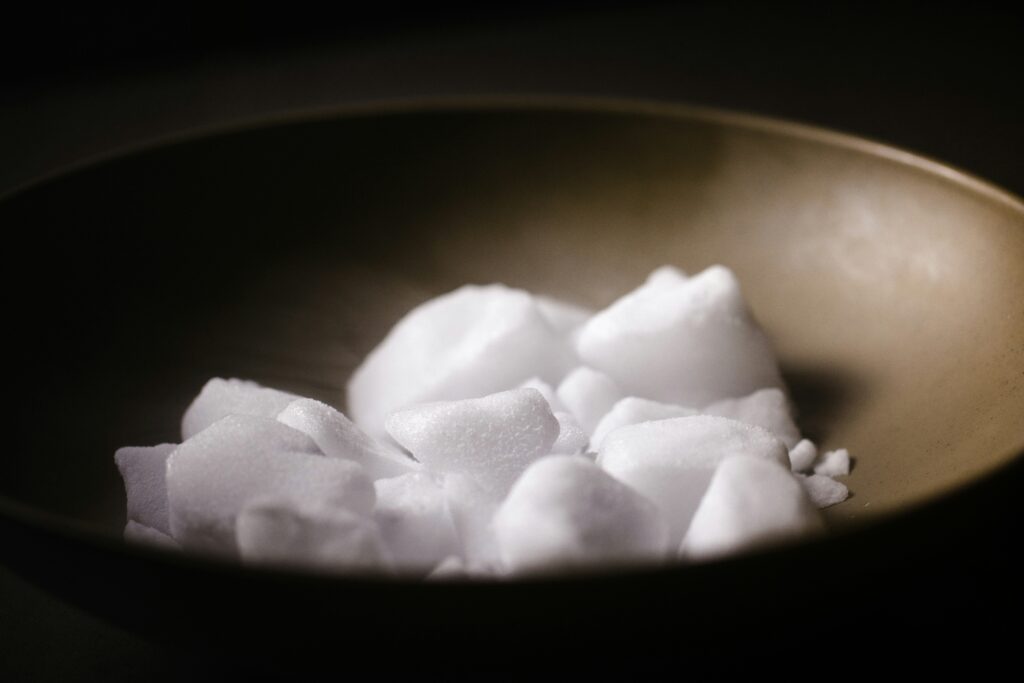
Erythritol is a low-calorie sweetener that tastes about 60-80% as sweet as table sugar, has near-zero calories (0.2 kcal/g), doesn’t raise blood sugar or insulin in healthy adults, and is classified as Generally Recognized as Safe (GRAS) by the US Food and Drug Administration and reaffirmed as safe at typical dietary intakes by the European Food Safety Authority (EFSA) in its 2023 re-evaluation. A 2023 Nature Medicine observational study raised questions about whether high circulating erythritol levels are associated with cardiovascular events (Witkowski et al., Nat Med 2023, PMID 36849732) — a finding that triggered considerable media coverage and ongoing scientific debate.
This guide walks through what erythritol is and where it comes from, what controlled trials show about its effect on blood sugar, how it compares to sugar in calories and sweetness, the unresolved cardiovascular safety question, common digestive side effects, and how a continuous glucose monitor or smart ring can help you understand its real-world effect on your own body.
What erythritol is and where it comes from
Erythritol is a sweetener that occurs naturally in small amounts in fruits like pears and watermelon, and in fermented foods like wine and soy sauce. The erythritol sold commercially is made by yeast fermentation of corn glucose — a process first introduced in Japan in the 1990s. It received Generally Recognized As Safe (GRAS) status from the FDA in 1997, was first approved as a food additive by the European Food Safety Authority in 2003, and was reaffirmed by EFSA’s 2023 re-evaluation as safe at typical dietary intakes.
In the body, erythritol is absorbed quickly in the small intestine (around 90% absorption), travels through the bloodstream, and is excreted essentially unchanged in urine within 24-48 hours. Most of it gets absorbed before reaching the colon, which is why it tends to cause fewer digestive symptoms than other sugar alcohols like xylitol, maltitol, or sorbitol.
Erythritol and blood sugar — what the research shows
In controlled human trials, erythritol has no meaningful effect on blood sugar or insulin in healthy adults or in adults with obesity. The Wolnerhanssen 2021 trial published in Nutrients gave adults with obesity erythritol or xylitol daily for 4 weeks and found that erythritol didn’t affect blood-sugar control after meals (Wölnerhanssen et al., Nutrients 2021, PMID 34836205).
A follow-up dose-ranging study published in the International Journal of Molecular Sciences confirmed that single servings of erythritol caused minimal blood-sugar or insulin response across all doses tested, consistent with erythritol’s glycemic index of 0 — the lowest possible score on the scale that measures how much a food raises blood sugar (Wölnerhanssen et al., IJMS 2022, PMID 36077269).
The reason is simple: the body doesn’t break erythritol down for energy. It’s absorbed, circulates briefly in the bloodstream, and is filtered out by the kidneys — no rise in blood sugar, no insulin response. For people managing blood sugar — prediabetes, type 2 diabetes, or athletes optimizing fueling — erythritol is one of the cleanest sweeteners from a glycemic standpoint.
Calorie content and sweetness compared to sugar
Erythritol provides approximately 0.2 calories per gram, compared to 4 calories per gram for sucrose (table sugar). On a sweetness basis, erythritol is roughly 60-80% as sweet as sugar, depending on the food matrix. In a typical recipe replacement, slightly more erythritol is used to match sugar’s sweetness:
- Table sugar: 4 kcal/g, 100% sweetness reference
- Erythritol: 0.2 kcal/g, ~70% sweetness
- Net result: roughly 90-95% calorie reduction at equivalent sweetness (approximate; varies by recipe)
Erythritol has a slight cooling sensation on the palate (because dissolving it absorbs heat from the mouth) and lacks the bulking and browning properties of sugar in baking. It’s often blended with stevia, monk fruit, or sucralose in commercial sweetener products to mask the cooling note and improve sugar-like behavior in recipes.
The 2023 cardiovascular safety question
In February 2023, Nature Medicine published an observational study by Witkowski and colleagues at the Cleveland Clinic that found higher erythritol levels in the blood were linked to roughly twice the risk of heart attacks, strokes, and deaths over three years in two groups of patients already at elevated heart-disease risk. The authors also reported lab and animal experiments suggesting erythritol may make blood more likely to clot (Witkowski et al., Nat Med 2023, PMID 36849732).
The finding generated significant media attention but is more complicated than headlines suggested:
- The study measured circulating erythritol in blood, not dietary intake. The body naturally produces small amounts of erythritol on its own, and an estimated 80% of the erythritol measured in the blood of people who don’t eat sweeteners comes from this internal production, not from food.
- A 2023 review in Nutrients argued that high erythritol in the blood may simply be a signal that the body’s metabolism is already under stress (from insulin resistance or other underlying issues), rather than a direct cause of heart problems — the chicken-or-egg question is genuinely unresolved (Mazi & Stanhope, Nutrients 2023, PMID 37764794).
- A separate 5-week pilot RCT published in BMJ Nutrition Prevention & Health gave adults with obesity erythritol or xylitol daily and found no adverse effects on vascular function, abdominal fat, or glucose tolerance over the trial period (Bordier et al., 2023, PMID 38618550).
- A 2025 European Heart Journal commentary from the original Witkowski group continues to flag erythritol and xylitol as worth ongoing investigation, while regulatory bodies have not changed their safety assessments (Witkowski & Hazen, Eur Heart J 2025, PMID 39565321).
Important: If you have established cardiovascular disease, a history of clotting events, or are at elevated cardiovascular risk, discuss erythritol use with your cardiologist or primary care provider. For most healthy adults using erythritol at typical food-use levels, current regulatory guidance from the FDA and EFSA remains that it is safe — but the cardiovascular question is not fully settled.
Side effects and digestive tolerance
The most common side effects of erythritol are gastrointestinal: bloating, gas, and loose stools. Because ~90% of erythritol is absorbed in the small intestine, it produces fewer of these symptoms than other sugar alcohols (xylitol, maltitol, sorbitol), which ferment heavily in the colon. Studies typically find that adults handle erythritol at moderate doses (roughly 0.5-0.8 g per kilogram of body weight in a single sitting, which is around 35-55 g for an average adult) without significant GI symptoms. Tolerance varies by individual body weight and sensitivity, and EFSA’s 2023 re-evaluation noted that higher single doses can trigger laxative effects in some adults.
Unlike xylitol — which is highly toxic to dogs even in small amounts — erythritol is a different sugar alcohol with a different toxicology profile. If your pet ingests any sugar alcohol, contact your veterinarian or an animal poison control hotline for specific guidance, especially for animals with existing health conditions.
Erythritol doesn’t promote tooth decay. A 3-year randomized trial in children published in Caries Research found that erythritol-containing candies were more effective than xylitol at preventing new cavities, and several dental health products use erythritol for this reason (Honkala et al., Caries Res 2014, PMID 24852946).
How a wearable can help you test erythritol on your own body
Individual glucose responses to sweeteners vary, and population-average findings don’t always reflect what happens in your body. A continuous glucose monitor (CGM) like the Ultrahuman M1 lets you test erythritol’s actual impact on your blood glucose under your own conditions — in your usual coffee, baked into a typical breakfast, or as part of a sweet drink. In most healthy adults the CGM trace will be essentially flat after erythritol, consistent with the controlled-trial data, but individual variation does exist (especially when erythritol is combined with other macronutrients).
Smart rings like the Ultrahuman Ring AIR or Ring PRO don’t measure blood sugar directly — a CGM remains the relevant tool for testing erythritol’s effect on your glucose. For broader lifestyle tracking around your diet, a smart ring’s sleep, resting heart rate, and HRV data are useful context, though there’s no specific research linking erythritol to changes in these metrics.
This article is for informational purposes and is not medical advice. People with cardiovascular disease, kidney disease, or other chronic medical conditions should discuss sweetener choices with their healthcare provider. Disclosure: Ultrahuman sells the Ring AIR and Ring PRO and the M1 continuous glucose monitor. These products support self-tracking but are not diagnostic tools and do not replace clinical care.
Practical guidance for using erythritol
- Start with small doses. First-time users may want to begin with smaller amounts — under 20 g a day is a common starting point — and increase gradually based on personal GI tolerance.
- Blend with other sweeteners. Most commercial “erythritol” products are blended with stevia, monk fruit, or sucralose to mask the cooling sensation and improve sweetness.
- Mind the dose in single foods. A keto dessert that uses 50+ g of erythritol may exceed your individual GI tolerance even if your daily total looks reasonable.
- If you have established cardiovascular disease, raise erythritol use with your cardiologist given the unresolved safety questions — there are alternative sweeteners (stevia, monk fruit) with different evidence profiles to consider.
- For diabetes or prediabetes, the glycemic neutrality of erythritol in clinical trials makes it a useful sweetener option to discuss with your diabetes care team. Individual CGM testing is the most informative way to confirm your personal response.