



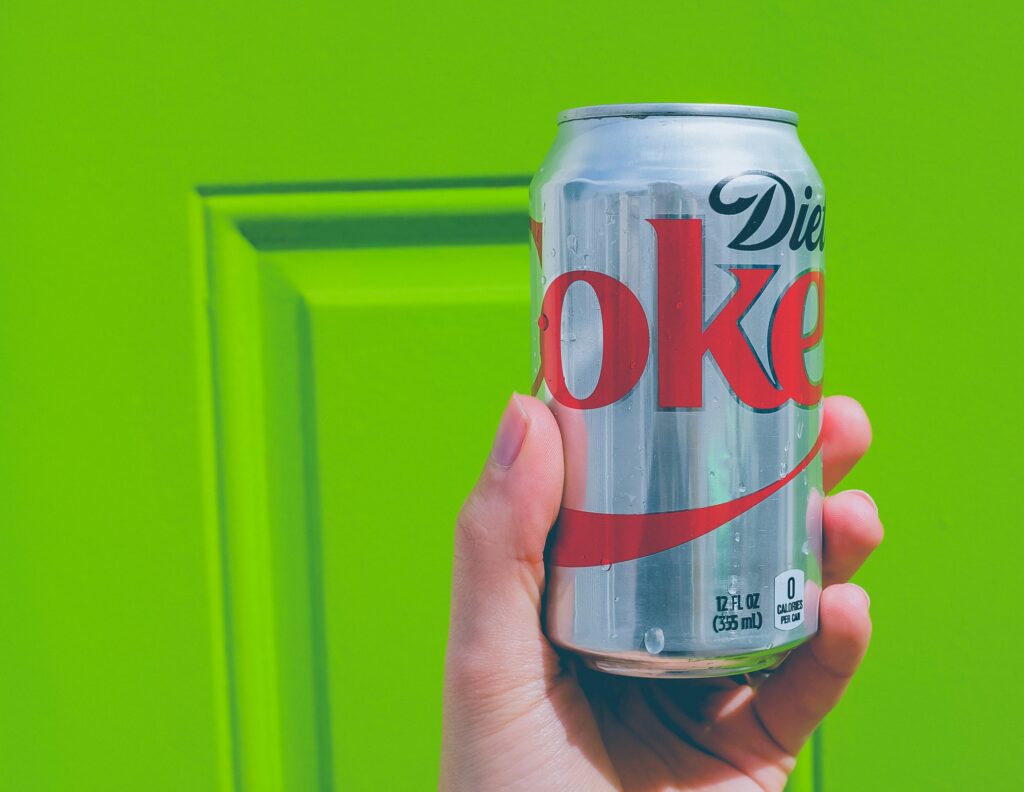
The short answer — Diet Coke isn’t dangerous for most people in moderate consumption, but it isn’t a free pass either. CGM data shows minimal direct glucose response, regulators broadly consider aspartame safe, and the gut-microbiome and cardiometabolic research shows modest effects rather than dramatic harm.
Diet Coke contains aspartame and acesulfame potassium — zero-calorie sweeteners — plus caffeine and acidulants. Aspartame has no fermentable carbohydrate, so it produces little to no direct blood-glucose response in continuous glucose monitor (CGM) data. The bigger questions are whether aspartame is safe long-term, whether non-nutritive sweeteners affect gut microbiome and glucose tolerance indirectly, and whether regular consumption raises cardiometabolic risk over time.
This guide walks through what’s in Diet Coke, the CGM data on its glucose response, the aspartame safety evidence (FDA, EFSA, WHO and IARC), the gut-microbiome research that’s complicated the picture, and the large cohort studies on cardiometabolic outcomes — then where the practical bottom line lands.
What’s in Diet Coke
A standard 12 oz can of Diet Coke contains roughly:
- Carbonated water (the bulk)
- Caramel colour (E150d)
- Phosphoric acid (acidulant, contributes to the tart taste)
- Aspartame (the primary sweetener)
- Potassium benzoate (preservative)
- Caffeine (~46 mg per 12 oz can, less than a typical cup of coffee)
- Natural flavours and small amounts of citric acid
- Acesulfame potassium (ace-K, in some formulations)
Aspartame is roughly 200 times sweeter than sucrose by weight, which is why a tiny amount produces the cola sweetness. It’s metabolised into aspartic acid, phenylalanine, and methanol — the same amino acids and alcohol found naturally in many everyday foods. For most people, the metabolism is unremarkable. People with phenylketonuria (PKU — a rare inherited disorder that prevents normal phenylalanine breakdown) need to avoid aspartame, which is why every aspartame-containing product carries a PKU warning label.
Does Diet Coke raise blood sugar?
Methodology note — OGdB metrics are aggregated from anonymised M1 CGM user food-log + glucose-pair data. “Peak value” is the post-consumption glucose maximum; “stable response” means the peak rise stayed within OGdB’s stability threshold for that user. Food Score (out of 10) is Ultrahuman’s composite of peak magnitude and stability across the user cohort. Sample sizes and detailed cohort breakdown are available on each OGdB product page. Individual responses vary substantially by person, meal context, and circadian timing.
In Ultrahuman’s Open Glucose Database (OGdB) — a continuous-glucose-monitor cohort dataset built from M1 CGM users — Diet Coke shows an average peak glucose value of 112 mg/dL, well within the normal post-meal glucose range. 81% of Ultrahuman users record a stable glucose response to it, and the average Food Score is 8 out of 10. This matches the underlying biochemistry — aspartame and acesulfame potassium contain no fermentable carbohydrate, so they’re not glycemic substrates.
Within the broader diet-soda category, Ultrahuman user data shows similar stable responses across brands:
| Diet soda | UH Food Score | Notes |
|---|---|---|
| Diet Coke | 8/10 | Avg peak 112 mg/dL; 81% stable response |
| Diet Coca Cola Can | 8/10 | Stable response |
| Diet Soda | 7/10 | Generally stable |
| Diet Coca Cola | 7/10 | Generally stable |
| Diet Pepsi | 6/10 | More variation |
The differences likely reflect variations in sweetener mix, sample size, and user logging context. The general pattern holds across brands — diet sodas produce minimal direct glucose response.
The minimal glucose response to Diet Coke contrasts sharply with regular Coke, which produces a sharp post-consumption spike from its 39 grams of sugar. From a pure CGM-glucose perspective, Diet Coke is a far better option than sugar-sweetened soft drinks for someone trying to keep glucose stable.
But “no glucose spike” doesn’t necessarily mean “no metabolic effect.” The broader research has identified two indirect pathways where non-nutritive sweeteners may matter: gut-microbiome shifts that affect glucose tolerance over time, and longer-term cardiometabolic associations seen in large cohort studies. We cover both below.
Is aspartame actually safe?
Aspartame is one of the most-studied food additives in the world. Regulatory positions:
- US FDA has approved aspartame since 1981 with an Acceptable Daily Intake (ADI) of 50 mg per kilogram body weight — 3,500 mg/day for a 70 kg adult, well above typical Diet Coke consumption.
- EFSA (European Food Safety Authority) confirmed aspartame as safe in 2013, with an ADI of 40 mg/kg.
- WHO/IARC classified aspartame as “possibly carcinogenic to humans” (Group 2B) in July 2023, based on limited evidence of liver-cancer association in observational studies. Important context: IARC’s Group 2B includes substances where the evidence is limited and inconsistent, alongside everyday items like pickled vegetables and aloe vera leaf extract.
- JECFA (Joint FAO/WHO Expert Committee on Food Additives), released simultaneously with the IARC classification, reaffirmed the existing 40 mg/kg ADI and concluded that current consumption levels do not present a meaningful cancer risk.
- WHO Guideline (May 2023) on non-sugar sweeteners issued a conditional recommendation against using non-sugar sweeteners for weight control or non-communicable-disease risk reduction in the general population, citing low-certainty evidence (WHO non-sugar sweeteners guideline 2023).
The regulatory consensus is that aspartame is safe within standard consumption ranges. The IARC Group 2B classification looks alarming in headlines but reflects limited and inconsistent evidence in observational data, not a strong causal signal.
Does aspartame affect your gut microbiome?
The most-cited concern about non-nutritive sweeteners (NNS) is whether they affect gut bacteria and indirectly worsen glucose tolerance.
A landmark 2014 study in Nature found that saccharin (among other artificial sweeteners) induced glucose intolerance in mice by altering the gut microbiome, though the human signal was limited — a small follow-up cohort showed similar effects in some individuals (Suez et al., Nature 2014, PMID 25231862). The finding triggered substantial follow-up research and reframed how non-nutritive sweeteners are thought of — not as inert, but as biologically active substances that can shift gut ecology.
A later 2022 randomised study in Cell found that four common non-nutritive sweeteners (saccharin, sucralose, aspartame, and stevia) altered the gut microbiome and plasma metabolome in humans, and that two of them — saccharin and sucralose — impaired glycemic response in some participants. Notably, the response was personalised: not everyone showed the same effect, and aspartame had a smaller effect than saccharin or sucralose (Suez et al., Cell 2022, PMID 35987213).
The takeaway: NNS, including aspartame, can shift gut microbiome composition and affect glycemic response in some individuals, but the effect varies considerably from person to person. For most people, the effect is small. For some, it may be meaningful.
Does Diet Coke increase heart disease or diabetes risk?
Large prospective cohort studies have found associations between non-nutritive sweetener consumption and cardiometabolic outcomes, but the evidence is mixed and confounded by who consumes diet drinks.
A systematic review and meta-analysis in CMAJ of randomised controlled trials (RCTs) and prospective cohort studies found that non-nutritive sweeteners were not associated with weight loss in RCTs, and prospective cohort studies showed associations with modest weight gain and higher risk of obesity, type 2 diabetes, hypertension, and cardiovascular events (Azad et al., CMAJ 2017, PMID 28716847).
The complication is reverse causality — people who switch to diet drinks often do so because they’re already managing weight or diabetes risk. Disentangling whether diet drinks cause cardiometabolic harm versus simply mark a population already at elevated risk is genuinely difficult. The cohort signals are real but the causal interpretation is contested.
Practically — the evidence doesn’t support diet drinks as a weight-loss tool, but the comparison versus sugar-sweetened beverages still strongly favours diet alternatives.
For broader context on how hormonal and metabolic factors shape food cravings, see Ultrahuman’s how to balance hormones naturally guide.
Practical bottom line
For most people, Diet Coke is fine in moderation. The CGM data shows no direct glucose impact. The regulatory consensus supports aspartame safety at typical consumption levels. The gut-microbiome and cardiometabolic signals are real but modest, and they don’t change the fundamental comparison: Diet Coke is meaningfully better metabolically than sugar-sweetened Coke.
Where to be more cautious:
- Heavy daily consumption (multiple cans daily) is where the cohort-study signals are most concerning. Treat as a beverage of moderate use rather than continuous-intake.
- Phenylketonuria (PKU) is an absolute contraindication for aspartame.
- If you’re trying to break a sweet-taste habit — some research suggests sustained sweet-taste exposure (whether from sugar or non-nutritive sweeteners) maintains sugar cravings. Reducing all sweet beverages, not just sugar-sweetened ones, may help.
- If you’re noticing post-Diet Coke glucose patterns on a CGM, you may be one of the people whose individual microbiome responds to NNS. Trial reducing or eliminating Diet Coke and watch what your patterns do.
Diet Coke isn’t a metabolic disaster. It also isn’t a free pass. The honest answer is “unlikely to cause harm in moderate use, but not a substitute for water or unsweetened beverages.”
This article is for informational purposes and is not medical advice. Individual glucose and metabolic responses to non-nutritive sweeteners vary; discuss specific dietary changes with a clinician if you have diabetes, PKU, pregnancy considerations, or other medical conditions. Disclosure: Ultrahuman sells the M1 continuous glucose monitor (CGM), and the Open Glucose Database (OGdB) referenced in this article is built from anonymised M1 user data. Individual glycemic responses vary substantially by person, meal context, and circadian timing.