



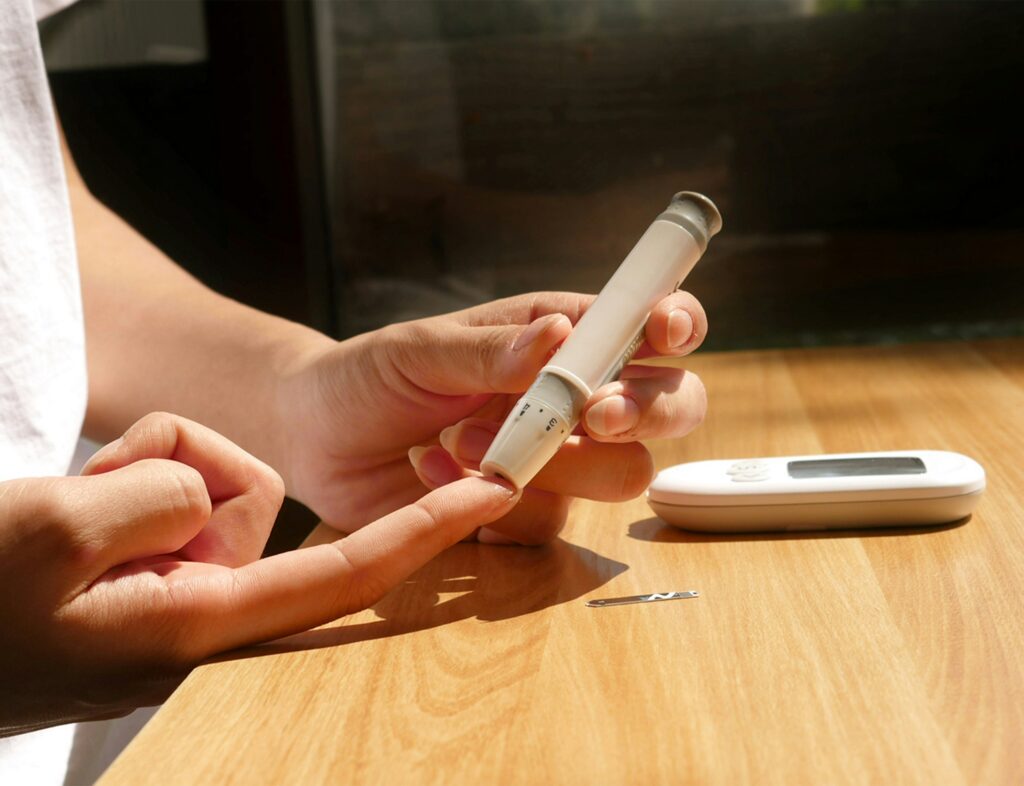
Your blood sugar is the amount of glucose circulating in your blood right now. For most adults without diabetes, it sits below 100 mg/dL (5.6 mmol/L) before eating and rises to under 140 mg/dL (7.8 mmol/L) two hours after a meal. But “normal” looks different at 8 years old, 38, and 78 — and it tightens significantly during pregnancy. This guide walks through the full chart by age, explains why each range exists, and shows how continuous glucose monitoring (CGM) data fills the picture a single lab number cannot.
A quick note on units. Two units are used worldwide. mg/dL (milligrams per deciliter) is standard in the US, Japan, France, and parts of Europe. mmol/L (millimoles per litre) is standard in the UK, India, Australia, Canada, and most of the rest of the world. We show both numbers throughout this guide. The conversion is simple: mg/dL ÷ 18 = mmol/L (so 100 mg/dL = 5.6 mmol/L).
The chart at a glance
Three tests are used to check your blood sugar:
- Fasting glucose — measured after 8+ hours without food, usually first thing in the morning
- 2-hour OGTT (oral glucose tolerance test) — your level two hours after drinking 75 grams of glucose; used to diagnose diabetes
- A1C — your average blood sugar over the past 2–3 months; no fasting required
The American Diabetes Association uses the bands below to label your result as Normal, Prediabetes, or Diabetes (American Diabetes Association, Diabetes Care 2026, PMID 41358893).
| Measurement | Normal | Prediabetes | Diabetes |
|---|---|---|---|
| Fasting glucose | < 100 mg/dL (< 5.6 mmol/L) | 100–125 mg/dL (5.6–6.9 mmol/L) | ≥ 126 mg/dL (≥ 7.0 mmol/L) |
| 2-hour OGTT | < 140 mg/dL (< 7.8 mmol/L) | 140–199 mg/dL (7.8–11.0 mmol/L) | ≥ 200 mg/dL (≥ 11.1 mmol/L) |
| A1C | < 5.7% | 5.7–6.4% | ≥ 6.5% |
| Random glucose (with symptoms) | — | — | ≥ 200 mg/dL (≥ 11.1 mmol/L) |
A diabetes diagnosis usually needs two abnormal results — either two different tests above the threshold, or the same test repeated on a separate day.
Why “by age” matters
The normal range is not a single line drawn the same way at every life stage. Three things change with age:
- Your body becomes less responsive to insulin with each decade past 40 — meaning the same meal raises your blood sugar more than it used to
- For older adults, the math shifts — avoiding dangerous lows from diabetes medication matters more than chasing complications that take decades to develop
- Pregnancy and childhood each have their own targets — a fasting number that is reassuring in a 30-year-old can be a warning sign in a pregnant woman
The sections below walk through each life stage.
Children and adolescents
For children without diabetes, the diagnostic thresholds match adults — fasting under 100 mg/dL (5.6 mmol/L), 2-hour OGTT under 140 mg/dL (7.8 mmol/L).
For children with type 1 diabetes (the most common form in kids), the ADA recommends (ADA Standards of Care, Chapter 14, Diabetes Care 2026, PMID 41358890):
- A1C: under 7.0%
- Before meals: 70–130 mg/dL (3.9–7.2 mmol/L)
- At bedtime: 80–140 mg/dL (4.4–7.8 mmol/L)
Targets are adjusted child by child. For kids who cannot easily feel when their blood sugar is dropping low (a condition called hypoglycemia unawareness), or whose family setup makes tight management harder, the team may loosen the A1C goal to under 7.5%. Continuous glucose monitoring is now standard care for pediatric type 1 diabetes — it cuts the risk of severe lows without sacrificing average control.
Adults without diabetes
For adults under 65 without diabetes, the master chart bands apply directly. A few practical points:
- A fasting glucose of 85–99 mg/dL (4.7–5.5 mmol/L) is in the normal range; the upper end of that band is worth tracking year-over-year if it is trending upward
- An occasional post-meal reading above 140 mg/dL (7.8 mmol/L) can occur even in healthy adults; CGM studies show meaningful day-to-day variability in non-diabetic glucose curves (Hall H et al., PLoS Biol 2018, PMID 30040822). It is the pattern over time, not one high number, that matters
- An A1C between 5.3 and 5.6% is normal; 5.7% and up enters the prediabetes band
For more on what your A1C means in mg/dL or mmol/L, see the Ultrahuman A1C calculator guide.
Adults with diabetes
For adults already diagnosed with type 1 or type 2 diabetes, the ADA’s day-to-day targets are (ADA Standards of Care, Chapter 6, Diabetes Care 2026, PMID 41358894):
- Before meals: 80–130 mg/dL (4.4–7.2 mmol/L)
- Peak after meals (1–2 hours later): under 180 mg/dL (under 10.0 mmol/L)
- A1C: under 7.0% for most adults
Your doctor may tighten or loosen these. Younger adults without other health problems may aim for an A1C under 6.5%; adults with multiple conditions or shorter life expectancy may aim for under 8.0%. The goal is balancing two risks — long-term complications of high blood sugar against the immediate danger of going too low from diabetes medication.
Older adults (65+)
Older adults are not one group. For older adults with diabetes, the ADA splits them into three tiers based on overall health, with a different target for each. (For older adults without diabetes, the normal-prediabetes-diabetes bands in the master chart above still apply.) The framework (ADA Standards of Care, Chapter 13, Diabetes Care 2026, PMID 41358888):
| Tier | Profile | A1C target | Fasting target |
|---|---|---|---|
| Healthy | Few other conditions, full memory and function | < 7.0–7.5% | 80–130 mg/dL (4.4–7.2 mmol/L) |
| Intermediate | Multiple conditions or mild memory issues | < 8.0% | 90–150 mg/dL (5.0–8.3 mmol/L) |
| Complex / poor health | Advanced illness, significant memory loss, or frailty | < 8.5% | 100–180 mg/dL (5.6–10.0 mmol/L) |
The targets relax with age and health because a tight A1C in an older adult on insulin or certain diabetes pills (like sulfonylureas, which can lower blood sugar more aggressively than newer medications) raises the risk of falls, fractures, and hospital admissions from dangerous lows. The benefit of preventing complications 30 years out also shrinks — that timeline matters more for a 50-year-old than an 85-year-old.
Pregnancy
Pregnancy is the one life stage when blood sugar targets are tighter, not looser. High blood sugar during pregnancy raises the risk of a larger-than-average baby (called large-for-gestational-age), preeclampsia (dangerous high blood pressure during pregnancy), and the newborn having low blood sugar after birth. The HAPO study found these risks rise continuously with maternal blood sugar — there is no specific number below which risk drops to zero (HAPO Study Cooperative Research Group, N Engl J Med 2008, PMID 18463375).
For pregnant women with diabetes (preexisting type 1, type 2, or pregnancy-induced), the ADA targets are (ADA Standards of Care, Chapter 15, Diabetes Care 2026, PMID 41358885):
- Fasting: under 95 mg/dL (under 5.3 mmol/L)
- 1 hour after a meal: under 140 mg/dL (under 7.8 mmol/L)
- 2 hours after a meal: under 120 mg/dL (under 6.7 mmol/L)
- A1C: under 6.0–6.5%, set with your obstetrician
Gestational diabetes is diabetes that develops during pregnancy. It is screened with a 75-gram OGTT between weeks 24 and 28. Any one of these results at or above threshold is enough for the diagnosis (IADPSG Consensus Panel, Diabetes Care 2010, PMID 20190296):
- Fasting ≥ 92 mg/dL (≥ 5.1 mmol/L)
- 1 hour ≥ 180 mg/dL (≥ 10.0 mmol/L)
- 2 hour ≥ 153 mg/dL (≥ 8.5 mmol/L)
If you are pregnant, your obstetric team will tell you when to test — do not use these numbers to self-screen in place of clinical care.
Time-in-range: the metric a chart cannot show you
A fasting number, a post-meal number, and an A1C are three snapshots. They can all sit in the normal band while your blood sugar is actually swinging widely throughout the day. CGM data fills that gap.
Time-in-Range (TIR) is the percentage of your day you spend inside a target glucose range. For most people with diabetes, the range is 70–180 mg/dL (3.9–10.0 mmol/L). The more time you spend inside the range, the better your day-to-day control. An international group of diabetes experts set the following TIR targets (Battelino T et al., Diabetes Care 2019, PMID 31177185):
| Population | Target glucose range | Time-in-range goal |
|---|---|---|
| Adults with type 1 or type 2 diabetes | 70–180 mg/dL (3.9–10.0 mmol/L) | ≥ 70% of day |
| Older or high-risk adults with diabetes | 70–180 mg/dL (3.9–10.0 mmol/L) | ≥ 50% of day |
| Pregnant women with type 1 diabetes | 63–140 mg/dL (3.5–7.8 mmol/L) | ≥ 70% of day |
For adults without diabetes, CGM data shows what a single lab test cannot — how steady (or jumpy) your blood sugar actually is, which foods spike you, and how sleep, stress, and exercise reshape your response. An Ultrahuman M1 CGM makes this visible day to day, rather than waiting for a quarterly lab. In a study Ultrahuman published in Scientific Reports in 2024, M1 CGM data over 14 days showed measurable differences in mean glucose, time spent in the tighter 70–110 mg/dL (3.9–6.1 mmol/L) range, and glucose variability between non-diabetic and pre-diabetic adults (N=105; Chaudhry M et al., Sci Rep 2024, PMID 38499685) — differences a one-off lab test would have missed.
What shifts your numbers
Four levers move your blood sugar quickly:
- Food choice and order. Eating fiber, protein, and fat before the carb portion of a meal flattens the post-meal spike noticeably (Shukla AP et al., Diabetes Care 2015, PMID 26106234)
- Movement after meals. A 10–15 minute walk after eating shuttles glucose into your muscles before insulin has to clear it (Reynolds AN et al., Diabetologia 2016, PMID 27747394)
- Sleep. A single short or fragmented night raises your fasting glucose the next morning (Donga E et al., J Clin Endocrinol Metab 2010, PMID 20371664); chronic poor sleep nudges your A1C up over months
- Stress. Cortisol — your main stress hormone — raises blood sugar. Long stretches of stress can lift your fasting number without any change in diet
For a deeper walkthrough of how to move your numbers, see the Ultrahuman guide on lowering A1C naturally. For the broader picture of what your readings mean and how to interpret them, see the ultimate guide to blood glucose levels.
When to talk to your healthcare provider
Talk to your provider if:
- Your fasting glucose is 100 mg/dL (5.6 mmol/L) or higher on two separate days — confirm with a lab test
- A random or post-meal reading is 200 mg/dL (11.1 mmol/L) or higher, especially with thirst, frequent urination, or unexplained weight loss
- Your A1C is 5.7% or higher — the prediabetes band is where lifestyle changes have the biggest payoff
- You are pregnant — your obstetric team will set your glucose-testing schedule, including a formal gestational diabetes screening between weeks 24 and 28; do not use the thresholds in this article to self-screen
- You are on diabetes medication and seeing frequent lows (under 70 mg/dL or 3.9 mmol/L) — your dose may need adjusting
This article is for informational purposes and is not medical advice. People with diabetes or suspected metabolic conditions should work with a clinician for diagnosis, medication, and treatment decisions. Disclosure: Ultrahuman sells the M1 CGM, Ring AIR, and Ring PRO referenced in this guide.