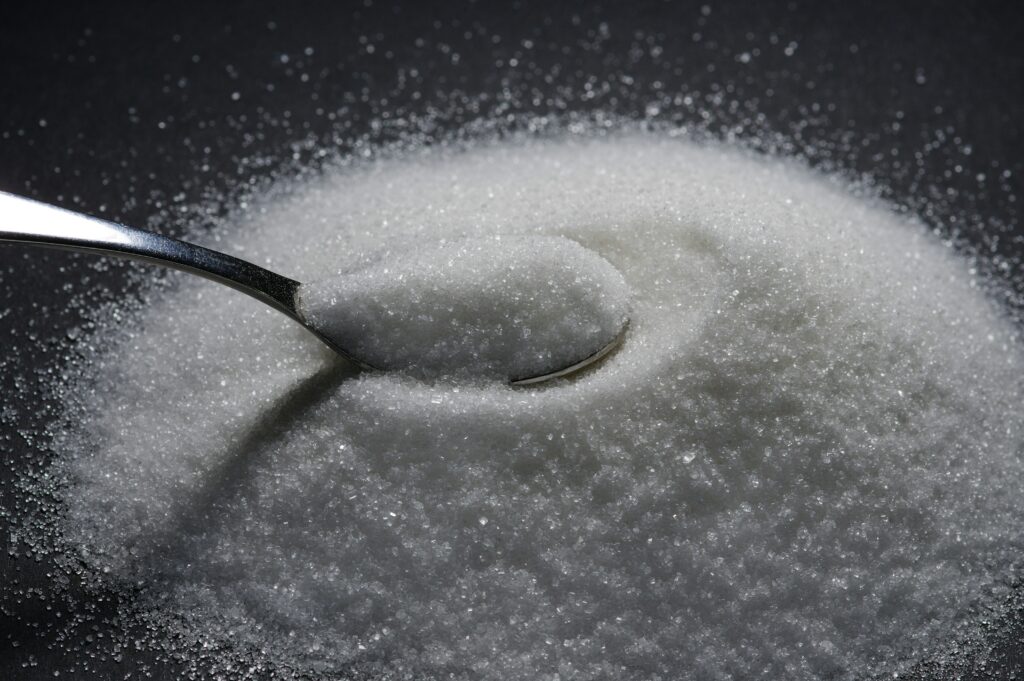



“Sugar” on a food label isn’t one ingredient. The names you’ll see — glucose, fructose, sucrose, high-fructose corn syrup, lactose, and a long list of “-oses” and syrups — are different forms of sweet carbohydrate, and they don’t all behave the same way in your body. Some spike your blood sugar fast (glucose, maltose). Some bypass blood sugar but get processed by your liver — where high or chronic intake can build up over time (fructose, HFCS). Some are barely absorbed at all (sugar alcohols like erythritol). This guide walks through each common type of sugar, what it actually does in your body, and how to spot it on an ingredient list.
The sugar chart at a glance
| Sugar | Family | Made of | Glycemic index* | Where you find it |
|---|---|---|---|---|
| Glucose | Monosaccharide | Single unit | 100 (reference) | Honey, dextrose, glucose syrup, fruit |
| Fructose | Monosaccharide | Single unit | ~19 | Fruit, honey, agave, HFCS |
| Galactose | Monosaccharide | Single unit | ~20 | Only from lactose digestion (dairy) |
| Sucrose | Disaccharide | Glucose + fructose | ~65 | Table sugar, cane sugar, beet sugar |
| Lactose | Disaccharide | Glucose + galactose | ~46 | Milk, yogurt, soft cheeses |
| Maltose | Disaccharide | Glucose + glucose | ~105 | Malted grains, beer, malt syrup |
| HFCS-55 | Added sweetener | 55% fructose + 45% glucose | ~58 | Soft drinks, sweetened drinks |
| Erythritol | Sugar alcohol | 4-carbon polyol | ~0 | Stevia blends, “zero-sugar” products |
*Glycemic index (GI) compares how fast a food raises blood glucose against pure glucose (set at 100). Lower numbers mean a slower, smaller blood-sugar rise. Reported GI values are approximate and vary by test food, population, and method. HFCS GI varies in real food matrices; the chart value reflects its calculated glucose-fructose composition. Reference values from the international GI table (Foster-Powell K et al.,* Am J Clin Nutr* 2002, PMID 12081815).
Monosaccharides — the building blocks
Monosaccharides are the simplest sugars. Every other sugar in your food eventually breaks down into one or two of these during digestion.
Glucose is the form your body actually uses for energy. When a glucose meter or CGM reports your “blood sugar,” it is reading glucose specifically. Pure glucose is the reference standard for glycemic index (set at 100), so every other carb is rated against it. Glucose is the fastest-absorbing sugar — it enters your bloodstream within minutes of eating and drives an immediate insulin response.
Fructose tastes the sweetest of the common sugars (roughly twice as sweet as glucose) and has a much lower glycemic index. The reason it does not spike blood sugar much — fructose is processed mostly by your liver and small intestine, not the bloodstream directly. That makes it less obvious on a CGM curve, but it does not make it metabolically free. With high or chronic intake, the liver converts excess fructose into fat through a process called de novo lipogenesis (Tappy L, Lê KA, Physiol Rev 2010, PMID 20086073) — which over time can contribute to non-alcoholic fatty liver disease, raised triglycerides, and reduced insulin sensitivity.
A 2018 study refined this picture — preclinical work showed that at moderate doses, the small intestine converts most dietary fructose into glucose and other organic acids before it reaches the liver. The liver only gets overwhelmed when fructose intake is high — like a large soft drink in one sitting (Jang C et al., Cell Metab 2018, PMID 29414685). So a piece of fruit is not the same as a 20-oz soda even though both contain fructose.
Galactose is the third monosaccharide. It only appears in your food as part of lactose (the sugar in milk). On its own, galactose is rare — your body sees it almost entirely after digesting dairy.
Disaccharides — the everyday sugars
Disaccharides are two monosaccharides chemically linked together. Your gut splits them apart within minutes of eating.
Sucrose is table sugar. It is one glucose linked to one fructose, in equal parts. Whether it comes from sugar cane or sugar beet, the molecule is the same. After your gut enzymes split it, the glucose half raises blood sugar quickly, and the fructose half heads to the liver. For more on how sucrose behaves in your body, see Ultrahuman’s sucrose explainer.
Lactose is milk sugar — glucose linked to galactose. Most adults outside Northern European and some African populations make less lactase (the enzyme that splits it) over time, which is why lactose intolerance is common worldwide. Lactose has a lower glycemic index than sucrose (around 46) because it is split more slowly and one of its halves is galactose, which does not raise blood sugar much.
Maltose is glucose linked to glucose. It is the main sugar in malted grains, beer, and malt syrup. Because both halves are glucose, maltose has the highest glycemic index of any common sugar (around 105) — it can spike blood glucose even faster than pure glucose itself.
Invert sugar is sucrose that has been pre-split into separate glucose and fructose. It is used widely in soft drinks, candies, and baked goods because it is sweeter per gram than table sugar and resists crystallization. For a deeper walkthrough, see Ultrahuman’s invert sugar explainer.
High-fructose corn syrup (HFCS) — its own category
HFCS is corn syrup that has been processed to convert some of its glucose into fructose. Two main blends are used commercially:
- HFCS-55 (approximately 55% fructose, 45% glucose) — the dominant sweetener in US soft drinks
- HFCS-42 (approximately 42% fructose, 58% glucose) — used in baked goods, breakfast cereals, and processed foods
The composition of HFCS-55 is close to sucrose’s 50-50 ratio, which is why most modern reviews conclude that HFCS and sucrose behave similarly in the body at the same total dose. Where HFCS is implicated in metabolic harm, the issue is usually total sweetened-beverage intake rather than HFCS specifically. Bray and colleagues’ 2004 paper proposed that rising HFCS consumption in beverages tracked closely with the US obesity epidemic over the 1980s and 1990s (Bray GA et al., Am J Clin Nutr 2004, PMID 15051594) — the broader takeaway is that liquid sugar in any form (HFCS, sucrose, invert sugar, fruit juice) tends to drive higher intake than the same calories eaten as solid food.
Why fructose gets special attention
Fructose is the only common sugar that bypasses the bloodstream for direct liver processing. Glucose feeds every cell in your body; fructose is handled mostly by your liver and (per the Jang 2018 finding) by your small intestine before reaching the liver.
This matters when fructose intake gets high. A 10-week trial by Stanhope and colleagues fed overweight and obese adults beverages sweetened with either pure glucose or pure fructose. With calories matched, the fructose group showed more deep belly fat (the kind that wraps around your organs, called visceral fat), more liver-fat production, and a worse response to insulin — effects the glucose group did not show (Stanhope KL et al., J Clin Invest 2009, PMID 19381015).
Meta-analytic evidence supports the broader sugar-and-weight link: a 2012 BMJ review found that reducing added sugar intake was associated with reduced body weight, while increasing it produced the opposite effect (Te Morenga L et al., BMJ 2012, PMID 23321486). And added sugar intake has been linked to cardiovascular mortality: a JAMA Internal Medicine analysis of US adults found that those consuming 25% or more of daily calories from added sugar had roughly twice the cardiovascular-disease mortality risk of those consuming less than 10% (Yang Q et al., JAMA Intern Med 2014, PMID 24493081).
For context, the WHO recommends keeping free sugars (added sugars plus those naturally present in honey, syrups, and fruit juices) below 10% of daily calories, ideally below 5% (about 25 grams per day for an average adult).
Sugar alcohols — the low-glycemic option
Sugar alcohols are sweeteners that taste sweet but are only partially digested. Common ones include erythritol, xylitol, sorbitol, mannitol, and maltitol. They have a much lower glycemic index than regular sugar (erythritol is essentially zero), so they are widely used in “sugar-free” and “keto” products.
The trade-off is gastrointestinal: sugar alcohols can cause bloating, gas, and diarrhea when eaten in larger amounts, because the undigested portion ferments in the colon. Erythritol is the best-tolerated of the group at moderate intakes. For a deeper look at erythritol specifically, see Ultrahuman’s erythritol explainer.
A note on artificial sweeteners
Artificial sweeteners (aspartame, sucralose, saccharin) and natural high-intensity sweeteners (stevia, monk fruit) are different from sugar alcohols. They are not carbohydrates, do not contain calories, and do not raise blood glucose on their own. Whether they have other metabolic effects is still being studied, but they are categorically distinct from the sugars in this guide.
How to spot sugar on a food label
Food labels list added sugar under many different names. All of these mean sugar in some form:
- Anything ending in “-ose”: sucrose, glucose, fructose, dextrose, maltose, lactose
- Syrups: corn syrup, high-fructose corn syrup, brown rice syrup, agave syrup, maple syrup, golden syrup, malt syrup
- Sugars by source: cane sugar, beet sugar, coconut sugar, palm sugar, date sugar, muscovado
- Concentrated forms: fruit juice concentrate, honey, molasses
Most of these break down into glucose and fructose during digestion — with two exceptions worth noting: lactose splits into glucose and galactose (not fructose), and sugar alcohols are only partially absorbed without raising blood glucose much. “Natural” sweeteners like honey, agave, and maple syrup deliver similar sugars to their refined counterparts on a gram-for-gram basis, though water content and total sugar density vary by product. For more on how added sugar shows up on a CGM and what targets to aim for at your life stage, see Ultrahuman’s blood sugar levels chart by age.
When to talk to your healthcare provider
Talk to your provider if:
- Your added sugar intake is regularly above 10% of daily calories (about 50 grams for an average adult) and your fasting glucose, triglycerides, or weight are trending up
- You have been told you have prediabetes, fatty liver, or high triglycerides — reducing fructose-heavy sweeteners (HFCS, sucrose, fruit juice) is often part of the first-line lifestyle plan
- You are pregnant — your obstetric team will tailor sugar and overall carbohydrate guidance to your specific situation
- You are managing diabetes — sweetener choices may interact with your medication and overall glycemic plan
This article is for informational purposes and is not medical advice. People with diabetes, prediabetes, or fatty liver should discuss specific sweetener and dietary choices with a clinician or registered dietitian. Disclosure: Ultrahuman sells the M1 CGM, Ring AIR, and Ring PRO referenced in this guide.