


Naps are an underrated yet powerful tool for boosting performance, cognition, mood, and recovery in adults. Short, well-timed naps can provide noticeable benefits – without many downsides. But not all naps are created equal – the length, timing, and even how you wake up matter.
It’s normal to feel sleepy during the afternoon due to the buildup of adenosine, the neurotransmitter that promotes sleep. A quick 20-minute power nap can sharpen your focus, but the wrong nap length can leave you feeling foggy. A study of nap durations found that short naps improved alertness with minimal sleep inertia, while 30-minute naps produced memory-encoding benefits.
The difference comes down to how far you let your brain wander into the sleep cycle. Here’s how to nap wisely and wake up refreshed.
Read next: How to make napping your superpower
How long should a nap be?
The ideal duration for a nap is around 20 minutes, which gives your body enough time to recover while preventing slipping into deep sleep.
As you sleep, you pass through different sleep stages: light sleep, deep sleep, and (rapid eye movement) REM sleep.
The first stage of sleep is non-REM sleep, when it’s easy to reawaken. In the second stage, the body temperature and heart rate reduce, and your breathing slows. In the third, your body goes into deep sleep and starts repairing.
While deep sleep strengthens your declarative memory and repairs muscles, tissues, and organs, if you wake up during deep sleep, you’re more likely to feel groggy.
Naps over 30 minutes risk entering deep sleep and waking mid-cycle, and won’t leave you feeling refreshed on waking up.
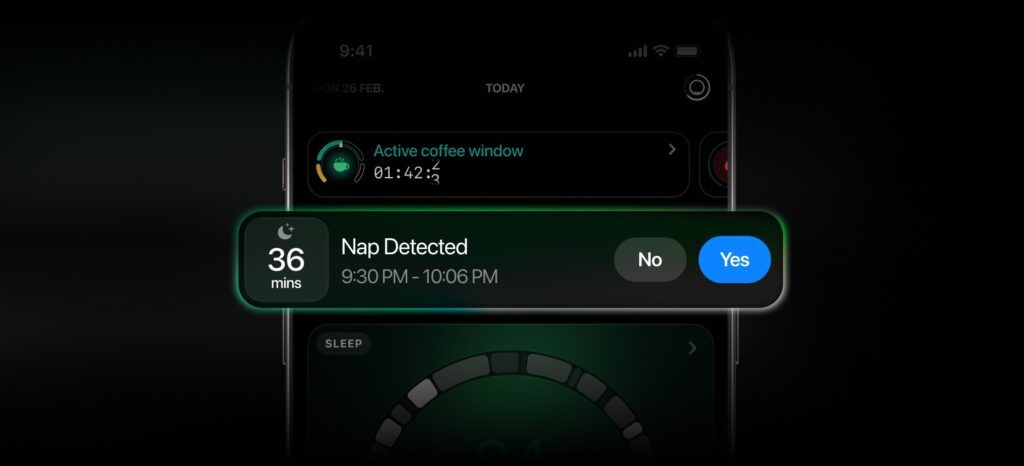
Learn how the Ultrahuman Ring AIR is more acurate for nap tracking
When should you nap?
The timing of naps matters, too. For most adults with a typical sleep schedule, the most beneficial window is roughly early afternoon, during the natural post‑lunch dip. That means around 1-3 PM.
Naps in this window align with circadian rhythms, improving alertness, mood, and cognitive performance.
Napping late in the afternoon or early evening is more likely to delay sleep onset at night and fragment nighttime sleep. Some research links longer daytime naps with higher risks of obesity and cardiovascular disease, although it’s not clear here whether people with these underlying conditions are simply more prone to napping. Rest assured that good quality, short naps are beneficial.
How to tailor your nap length to your needs
10–20 minutes (The Core Boost): This is the sweet spot for daytime rest. In this window, you remain in light sleep (Stages 1 and 2), which restores alertness, sharpens focus, and provides an immediate energy lift – without the grogginess that comes from deeper stages.
30 minutes (The Danger Zone): At around the half-hour mark, the brain begins to drift into deeper sleep. Waking during this phase can trigger sleep inertia – characterized by sluggishness, disorientation, and reduced performance.
60 minutes (The Memory Nap): A one-hour nap allows you to enter slow-wave sleep, which plays a critical role in memory consolidation and learning. However, waking up mid-cycle often brings 10–30 minutes of grogginess before the restorative benefits are fully felt, and it can affect your ability to sleep later.
90 minutes (The Full Cycle Reset): A 90-minute nap typically covers a complete sleep cycle, moving through light sleep, deep sleep, and REM. This length supports creativity, emotional regulation, and physical recovery. This longer nap length is particularly valuable for athletes, shift workers, or anyone recovering from significant sleep debt – but it can make it harder to sleep in the evening.
Tips for a quality nap:
- Set an alarm. Don’t “free nap” unless you want to risk waking up mid-cycle.
- Timing is everything. Aim for early afternoon (1–3 PM). Too late in the day, and you’ll sabotage your nighttime sleep.
- Environment matters. Dark, cool, and quiet spaces help your brain switch off faster.
References
- Ultrahuman Blog: Why naps are the secret to living stronger, smarter, and longer
- Adenosine and Sleep: Understanding Your Sleep Drive by Sleep Doctor
- Leong RLF, Lau T, Dicom AR, Teo TB, Ong JL, Chee MWL. Influence of mid-afternoon nap duration and sleep parameters on memory encoding, mood, processing speed, and vigilance. Sleep. 2023 Apr 12;46(4):zsad025. PMID: 36775965; PMCID: PMC10091091.
- Trotti LM. Waking up is the hardest thing I do all day: Sleep inertia and sleep drunkenness. Sleep Med Rev. 2017 Oct;35:76-84. Epub 2016 Sep 4. PMID: 27692973; PMCID: PMC5337178.
- Dutheil F, Danini B, Bagheri R, Fantini ML, Pereira B, Moustafa F, Trousselard M, Navel V. Effects of a Short Daytime Nap on the Cognitive Performance: A Systematic Review and Meta-Analysis. Int J Environ Res Public Health. 2021 Sep 28;18(19):10212. PMID: 34639511; PMCID: PMC8507757.
- Vizmanos B, Cascales AI, Rodríguez-Martín M, Salmerón D, Morales E, Aragón-Alonso A, Scheer FAJL, Garaulet M. Lifestyle mediators of associations among siestas, obesity, and metabolic health. Obesity (Silver Spring). 2023 May;31(5):1227-1239. PMID: 37140401.
- Sirohi P, Khan MH, Sharma S, Nuhmani S, Al Muslem WH, Abualait T. A systematic review of effects of daytime napping strategies on sports performance in physically active individuals with and without partial-sleep deprivation. PeerJ. 2022 Dec 1;10:e14460. PMID: 36518294; PMCID: PMC9744144.
- Oriyama S. Effects of 90- and 30-min naps or a 120-min nap on alertness and performance: reanalysis of an existing pilot study. Sci Rep. 2023 Jun 18;13(1):9862. PMID: 37332041; PMCID: PMC10277286.