


This article was medically reviewed by Kate Davies RN, BSc (Hons), FP Cert, Vice President Medical Women’s Health & Longevity at Ultrahuman.
Sore, tender breasts in perimenopause are common – and driven by erratic estrogen surges combined with falling progesterone.
Estrogen overstimulates breast tissue and pulls fluid into the ducts; progesterone usually balances that effect, but in perimenopause, cycles are increasingly anovulatory — meaning no egg is released, so the corpus luteum never forms and progesterone never gets made.
The result is unpredictable, often longer-lasting breast tenderness than the predictable PMS soreness of earlier decades. It can show up at any point in the cycle, not just before a period, and usually eases as the transition to menopause completes.
This guide explains the hormonal mechanism, how perimenopausal breast pain differs from regular PMS, what Ultrahuman Ring cycle data shows about this stage, and when soreness is worth a doctor visit rather than a wait.
Why your breasts feel different in perimenopause
Breast tissue is highly responsive to estrogen. Estrogen stimulates the ducts and increases fluid retention in the breast; progesterone, produced after ovulation, dampens that response and stabilizes the tissue.
In a typical 20s or 30s cycle, the two hormones move in a predictable rhythm (see Ultrahuman’s primer on hormones and blood testing for a deeper background).
During perimenopause, estradiol levels become more variable — sometimes spiking well above young-adult ranges, sometimes crashing within the same cycle.
Progesterone, in contrast, drops as more cycles pass without ovulation — what Prior describes as “decreased progesterone levels in normally ovulatory, short luteal phase or anovulatory cycles” (Prior JC, Front Biosci, 2011, PMID 21196391).
The net effect on breast tissue is what clinicians call unopposed estrogen exposure: stimulation without the calming progesterone signal. That is the underlying driver of perimenopausal mastalgia (cyclical breast pain). Across mid-life women, breast tenderness and night sweats peak in the same premenstrual window, suggesting shared hormonal drivers (Hale GE, Hitchcock CL, Williams LA, Vigna YM, Prior JC, Climacteric, 2003, PMID 12841883).
How perimenopause breast pain differs from PMS breast pain
The symptoms can feel similar but the timing and intensity follow a different pattern. The table below summarizes the differences clinicians use to distinguish them.
| Feature | PMS breast tenderness (20s–30s) | Perimenopause breast tenderness |
|---|---|---|
| Timing in cycle | Predictable: 5–10 days before period | Variable: any point, often unrelated to bleed |
| Duration | Resolves within a day or two of bleed start | Can persist 2+ weeks or across an entire cycle |
| Intensity | Mild to moderate, both breasts | Often sharper or burning; can be one-sided |
| Cycle pattern | Regular 25–32 day cycles | Cycles get shorter, then longer, then skip |
| Other symptoms alongside | Bloating, mood shifts | Night sweats, sleep disruption, irregular bleeding |
| What helps | NSAIDs, supportive bra, the period itself | Same plus addressing the underlying hormonal pattern |
The key practical signal: if breast pain is no longer predictable from the calendar, the cycle pattern itself has likely shifted. That is usually the more important data point than the soreness itself.
What does the cycle data show?
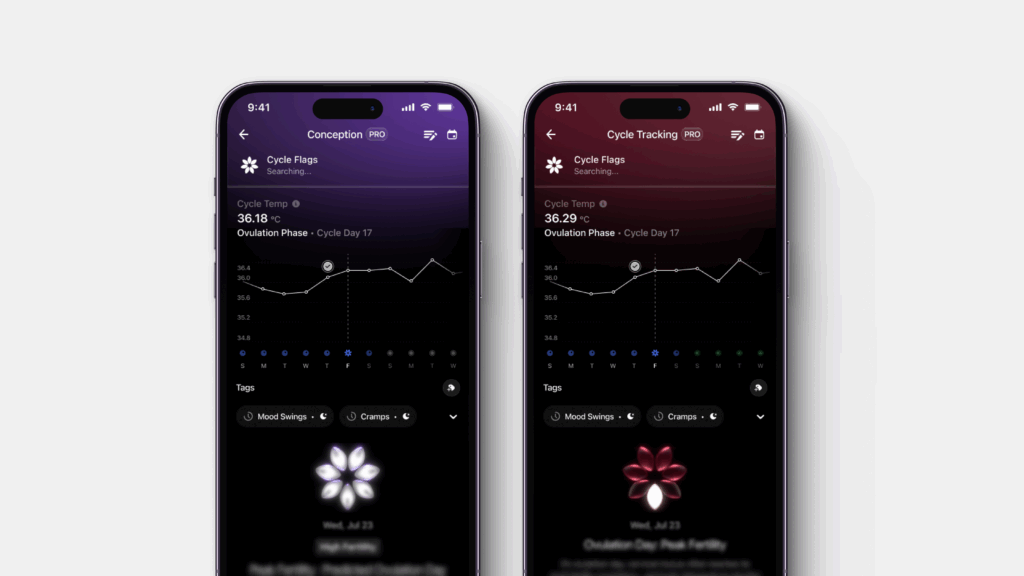
Breast tenderness in perimenopause is driven by anovulatory cycles — cycles where estrogen rises, but progesterone never gets made because ovulation skips. That hormonal pattern shows up at the cycle level as irregularity: cycles run longer and more variable as ovulation gets less reliable. The more cycles spent in this state, the more time spent in unopposed-estrogen windows that stimulate breast tissue without progesterone’s calming counterbalance. To see how often this is actually happening in perimenopause-age users, we looked at cycle data from the Ring.
Ultrahuman analyzed cycle patterns from 6,214 women aged 40–55 who had at least three recorded cycles and at least two cycles longer than 35 days — a population-level proxy for the menstrual irregularity that marks the perimenopausal transition. That cohort produced 123,053 completed cycles. We compared it against an age-matched control of 185,627 women aged 20–39 (1,994,495 cycles).
Two patterns stand out:
- Cycles get longer, more often. 24.5% of cycles in the perimenopause cohort ran longer than 35 days, compared to 17.1% in the younger control — a 7-percentage-point increase. The share of cycles longer than 60 days (the clinical marker for skipped periods) roughly doubled, from 5.1% to 8.2%.
- The variability widens, but the typical cycle is still typical. Standard deviation across the perimenopause cohort was 24 days — about 18% wider than the 20–39 control. The median cycle stayed at 28 days, near-normal. The story isn’t that every cycle changes; it’s that the tail of unusually long ones grows.
Both patterns point to more cycles where ovulation skips or delays as women get older. That means more time in unopposed-estrogen states — the hormonal context behind the sore, swollen breast symptoms women in this age range describe.
A note on the data. This cohort was defined by an analyst-applied filter, not by any prior perimenopause flag: women aged 40–55 whose Ring records contained at least 2 cycles longer than 35 days. The long-cycle pattern is a working proxy for the menstrual irregularity that marks perimenopause (recognized as the early marker in the STRAW+10 staging criteria), but it is not a clinical perimenopause diagnosis. So the figures show within-cohort prevalence under that filter, not population prevalence across all women aged 40–55. The 20–39 group is a younger reference, not an age-matched control. Observational wearable data, not a clinical study.
When does perimenopause breast tenderness peak?
For most women, breast tenderness is heaviest in the years when cycles are still happening but becoming irregular — usually the early-to-mid 40s, sometimes earlier. As ovulation becomes rarer and estrogen production from the ovaries declines toward postmenopausal levels, cyclical breast pain usually fades.
The timeline isn’t linear. Hormone levels swing erratically rather than declining steadily, and ovulatory disturbances increase as the transition progresses (Prior JC, Novartis Found Symp, 2002, PMID 11855687). Many women experience symptom flares followed by calmer stretches as a result.
What usually marks the end of perimenopausal breast tenderness:
- Twelve consecutive months without a period (the clinical definition of menopause)
- Sustained low estradiol with corresponding loss of cyclical breast stimulation
- Resolution of accompanying symptoms like night sweats and disrupted sleep
A note on individual variation, methodology, and conflict. Wearable-derived cycle signals (skin temperature, HRV, resting heart rate) vary across individuals based on baseline physiology, sleep quality, stress, and many other factors. The Ultrahuman perimenopause cohort is observational data — not a clinical study, not a diagnostic tool, and not a substitute for hormone-panel testing or evaluation by an OB/GYN. Persistent or one-sided breast pain should be assessed by a clinician regardless of what a wearable shows. Disclosure: Ultrahuman sells the Ring AIR referenced throughout this guide.
Managing perimenopause breast tenderness
Most cases respond to lifestyle changes that lower estrogen exposure and reduce the inflammatory load amplifying tissue sensitivity. The interventions below are widely recommended in clinical mastalgia guidance; the evidence base varies, and individual response varies more, so a several-week trial of any single change is the cleanest way to know if it helps.
- Reduce caffeine and alcohol. Both are commonly listed as triggers in mastalgia guidance, though the trial evidence is mixed. A several-week cut is low-cost and easy to evaluate.
- Increase fiber intake. The US Dietary Guidelines for Americans recommend roughly 25–30 g of fiber per day from vegetables, legumes, oats, and flax. Higher fiber intake supports the gut’s processing of estrogen metabolites.
- Support sleep. Sleep disruption is one of the most consistently reported perimenopause symptoms, and it interacts with the cortisol-and-sex-hormone axis. Ultrahuman’s look at women and sleep covers the female-specific picture.
- Wear a supportive bra during flare weeks. Mechanical support reduces pain from breast-tissue motion when ducts are inflamed.
- Consider evening primrose oil (EPO) and vitamin E. Both carry mixed evidence but appear in clinical mastalgia reviews as low-risk options worth a trial of several months.
- Discuss hormonal options with a clinician. Prescription options include cyclic progesterone, low-dose oral contraceptives, and menopausal hormone therapy. The Endocrine Society scientific statement reviews menopausal hormone therapy specifically in detail (Santen RJ et al., J Clin Endocrinol Metab, 2010, PMID 20566620); the other options should be discussed with a clinician who can weigh individual risk profile.
Track the response. If a change makes a difference, it usually shows up across a few cycles, not a single week.
When to see a doctor about breast pain
Cyclical, bilateral breast tenderness that comes and goes with hormonal shifts is almost always benign. But some patterns warrant medical evaluation, not because they are commonly cancer, but because cancer is what an exam rules out.
See a clinician promptly if you notice any of:
- A new lump, thickening, or asymmetric area you can feel
- Pain in one specific spot that doesn’t move with the cycle
- Skin changes: dimpling, puckering, redness, or scaling around the nipple
- Nipple discharge that is bloody, clear and spontaneous, or from only one side
- Pain accompanied by unexplained weight loss or fatigue
A clinical history and physical exam are the first step for distinguishing benign breast pain from anything that requires imaging; when imaging is indicated, the American College of Radiology Appropriateness Criteria guide whether mammography, ultrasound, or both are used (Bui AH et al., J Breast Imaging, 2024, PMID 38538078). Any of the red-flag patterns above warrants that clinical evaluation.
This article is for informational purposes and is not medical advice. Perimenopause symptoms vary widely, and any persistent or one-sided breast pain should be assessed by a clinician.