


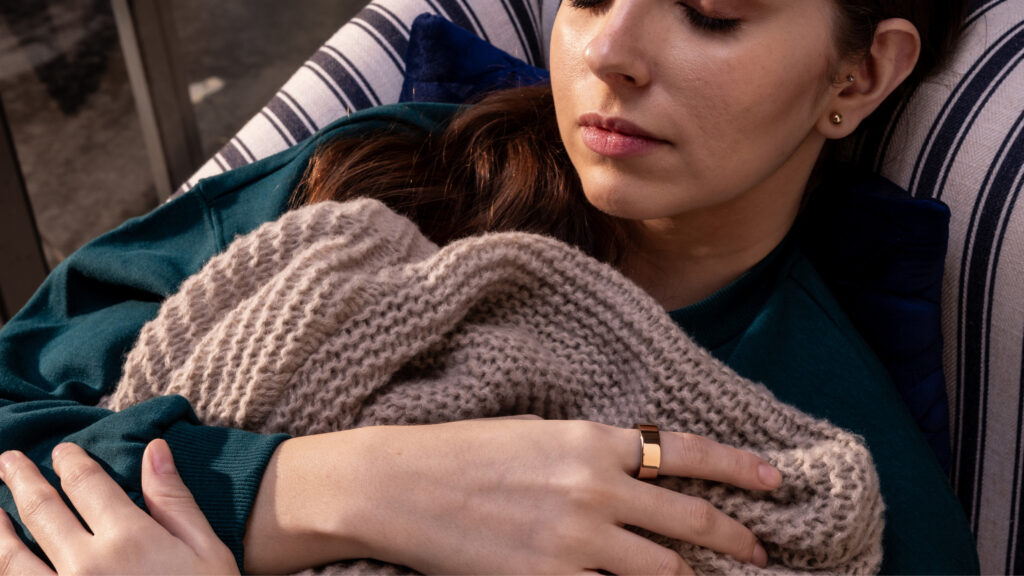
A new peer-reviewed study using the Ultrahuman Ring AIR has found a striking gap between how people think they sleep and what their body is actually doing.
The study, published this month in the Journal of Circadian Rhythms, was led by Matthew Driller and colleagues, an independent research group that used Ring AIR devices as an objective measure of sleep quality, after validating its accuracy against gold standard sleep-lab devices.
The team tracked 31 adults wearing Ring AIR for 21 consecutive nights and compared what the ring measured against a brief self-report tool called the Sleep Regularity Questionnaire.
Across every objective metric tested – Sleep Regularity Index, interdaily stability, social jetlag, composite phase deviation, and the night-to-night variability of sleep onset and wake time — what people said about their sleep differed from what the ring recorded.
And that has implications. Sleep regularity — the consistency of bed and wake times across days — is linked to elevated cardiometabolic risk, impaired cognitive function, and worse mental health outcomes, often regardless of total sleep duration. If sleep regularity is a target worth caring about, the field needs tools that can actually capture it.
“What this study shows is that how regular or consistent people think their sleep is doesn’t always match what we see from wearable data,” said lead research scientist Matt Driller.
“The exciting part is that sleep regularity is emerging as an important, separate dimension of sleep health, alongside sleep duration and quality. For a long time, the conversation has been dominated by ‘how long’ and ‘how well’ people sleep. This work adds to the regularity picture, and proposes it may be best measured with a combination of subjective and wearable tools,” he continued.
In a separate Ultrahuman study of 5,000+ users of Ring AIR and M1 CGM with Stanford University, the most regular sleepers were found to exhibit athlete-level glucose control, while the least consistent had glucose swings comparable to pre-diabetics.
For those running sleep studies, as well as general users, it shows that wearables provided a more accurate assessment of sleep regularity.
How the study worked
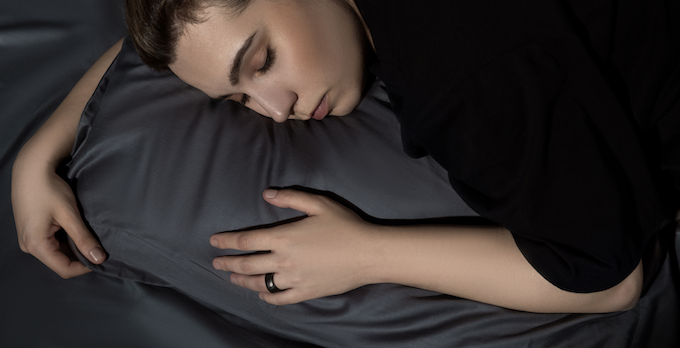
The researchers ran a two-part design. In Part 1, 31 adults wore the Ring AIR continuously for 21 nights, and the team pulled a suite of objective regularity indices from the device’s sleep–wake series.
The SRI calculation followed the RIRI (Reporting Items for Regularity Indices) framework — a 2026 standardisation effort from Czeisler and colleagues, designed to fix the fact that different SRI implementations can produce materially different results. In Part 2, a separate group of 52 adults completed a one-week sleep diary alongside the questionnaire.
The questionnaire scores didn’t line up with what the ring recorded. People simply aren’t good at judging how regular their own sleep is.
Validating Ring AIR
The supplementary materials of the study also report a head-to-head validation of the Ring AIR against Somfit — a single-channel EEG system itself validated against full polysomnography.
Across 20 paired nights, the ring and the EEG agreed on when sleep started to within 1.4 minutes, when it ended to within 3.6 minutes, and on total sleep time to within 1 minute. For practical purposes, the two devices were measuring the same thing.
Ring AIR’s correlation with the reference (r = 0.9998, ICC = 0.9997) is among the tightest reported for any consumer wearable for sleep onset and offset.
Conclusion
Self-report questionnaires have dominated sleep epidemiology for decades because they’re cheap, fast, and easy to deploy at scale.
The Pittsburgh Sleep Quality Index and similar tools sit behind a large share of what the public health world knows about sleep and disease risk.
But the evidence is mounting that people can’t reliably self-assess the dimensions of their sleep that matter most for long-term health.
That’s a problem for the next generation of clinical research. Studies linking sleep regularity to cardiometabolic outcomes, hormonal cycles, mental health, or recovery in clinical populations need measurement that’s objective, continuous, and scalable enough to deploy in large cohorts.
This study shows that wearables like the Ring AIR are accurate enough to provide validity.
Note on the validation data
The Ring AIR vs Somfit comparison was conducted across 20 paired nights in 4 participants. Full agreement statistics: sleep onset Pearson r = 0.9998, ICC = 0.9997, typical error 8.3 minutes; sleep offset r = 0.985, ICC = 0.974, typical error 8.0 minutes; total sleep time r = 0.889, ICC = 0.844, typical error 14.9 minutes, coefficient of variation 3.2%. Full details are available in the paper’s supplementary materials.